A complete overview of all 14 intensive courses I completed at the African Institute for Mathematical Sciences (AIMS) South Africa, with exact dates, lecturers, and key learning outcomes, plus my MSc thesis research.
Explored challenging elementary problems in number theory, combinatorics, probability, and geometry. Practiced mathematical investigation through understanding problems, exploring extreme cases, constructing proofs, and generalising. The three-week intensive culminated in a group presentation on "Strategising minimal ostrich egg drops to measure durability across 102 floors."
Explored Bayesian approaches to reasoning under uncertainty. Key topics: Bayes' theorem, prior and posterior probabilities, Bayes factors, discrete & continuous distributions, hypothesis testing, the likelihood principle, and Shannon information. Practical applications spanned medical testing, drug evaluation, legal reasoning, and the reproducibility crisis, including p-values, confidence intervals, and the Monty Hall problem.
Focused on geometric foundations of electromagnetism to strengthen physics problem-solving. Worked on translating complex physical scenarios into mathematical forms, scalar and vector fields in 3D. Emphasis on making approximations, applying idealisations, and creating visualisations. Frequent group work deepened understanding through shared insight.
Intensive Python programming using Jupyter notebooks, syntax, control flow, functions, classes, exceptions, NumPy, and Matplotlib. Introduced neural networks and analysed algorithm efficiency through time complexity estimation. Strong emphasis on hands-on coding and real problem-solving throughout.
Mathematical problem-solving through an experimental lens using SageMath, across algebra, combinatorics, number theory, calculus, and numerical mathematics. Covered programming fundamentals, data types, plotting, and interactive visualisations. Group project involved visualising a user network from JSONPlaceholder using the interact package.
Foundational modelling using differential and difference equations, conservation laws, constitutive relations. Applications in finance, population dynamics, and non-linear systems. Covered 1st and 2nd-order ODEs, Cauchy problems, global existence and positivity, and stability analysis using cobweb diagrams.
Foundations of quantum computing: Dirac notation, qubits, quantum gates, circuits, and measurement. Implemented protocols (BB84, dense coding, teleportation) using IBM Q via Qiskit. Covered Bernstein–Vazirani, Simon, Grover, Quantum Phase Estimation, and Shor's algorithms. Discussed Africa's quantum landscape, including Quantum Leap Africa and Wits/IBM partnerships.
Fundamentals of category theory, formal mathematical reasoning, set theory foundations, categories of finite sets and real matrices. Key topics: monomorphisms, epimorphisms, isomorphisms, initial and terminal objects, products and sums within categories. Connected abstract ideas to concrete structures including functions and geometric transformations.
Deep connections between abstract algebra and real-world problem-solving. From binary operations and relations to groups, rings, fields, and vector spaces, governed by axioms of closure, associativity, identity, and invertibility. Explored symmetry through groups, modular arithmetic, and polynomial equations through rings and fields.
Fundamental principles of fluid flow, Navier–Stokes equations, boundary layers, conservation laws. Explored vorticity dynamics, lift on an aerofoil, and instabilities in shear layers through theory and numerical techniques. Concluded with turbulence and hydrodynamic instabilities in natural and industrial phenomena.
Archetypal problems in industrial and scientific modelling, uncovering mathematical structures underlying diverse physical phenomena. Studied scaling, asymptotics, singular perturbation, variational approaches, Fourier methods, and PDEs. Applied to diffusion, nonlinear vibrations, wave dynamics, shock dynamics, and boundary layers.
Mathematical foundations of symmetry, patterns, and knot theory, revealing deep connections to African art and design. Covered Euclidean geometry, isometries, frieze and wallpaper patterns, graph theory (Euler cycles), Sona sand drawings, and knot theory with braid groups and hyperbolic tessellations.
Finite group actions on polynomial rings, invariant rings through Macaulay2, quotient varieties, commutative algebra (rings and ideals), linking group actions to geometric resolutions. Culminated in algebraic geometry, morphisms and schemes, with applications in cryptography and geometric visualisation.
Mathematical rigour in software development, program proofs, test generation via symbolic execution, automated defect detection. Propositional and predicate logic through to model checking, invariant inference, and program repair. Practical tool throughout the course: Dafny.
ODEs and PDEs modelling complex biological systems, population modelling, equilibrium analysis, and linear stability via phase-line and linearisation techniques. Advanced to multi-dimensional systems using matrix exponentials and eigenvalue analysis. Applied to multi-species interactions and spatial pattern formation.
Building on Quantum Computing, this course deepened mathematical structures of quantum mechanics and information theory. Shannon entropy and classical foundations, then quantum theory axiomatically: quantum states, observables, density matrices. Key topics: quantum entanglement, the no-cloning theorem, von Neumann entropy, and applications in quantum communication.
Mathematical foundations and real-world applications of complex networks, graph theory, probability, and statistical physics. Network representations, degree distributions, clustering, and centrality measures. Models: Erdős–Rényi random graphs and scale-free networks, with applications to biological, technological, and social systems.
Mathematical models of molecular biology using algebra, logic, and dynamical systems. Biochemical reaction networks via ODEs and delay DEs, the lac operon in E. coli. Boolean network models: structure, dynamics, and simplification. Reverse engineering network structure from data. Tools: Macaulay2, BoolNet, Cyclone, and GINsim.
The culminating research project of the AIMS MSc programme, an independent investigation supervised by Prof. Rebecca Killick of Lancaster University.
Supervisor: Professor Rebecca Killick · Lancaster University
Countries: Germany · Spain · Finland · Netherlands
Energy Types: Solar · Wind (Renewable) · Fossil Gas · Hard Coal (Non-Renewable)
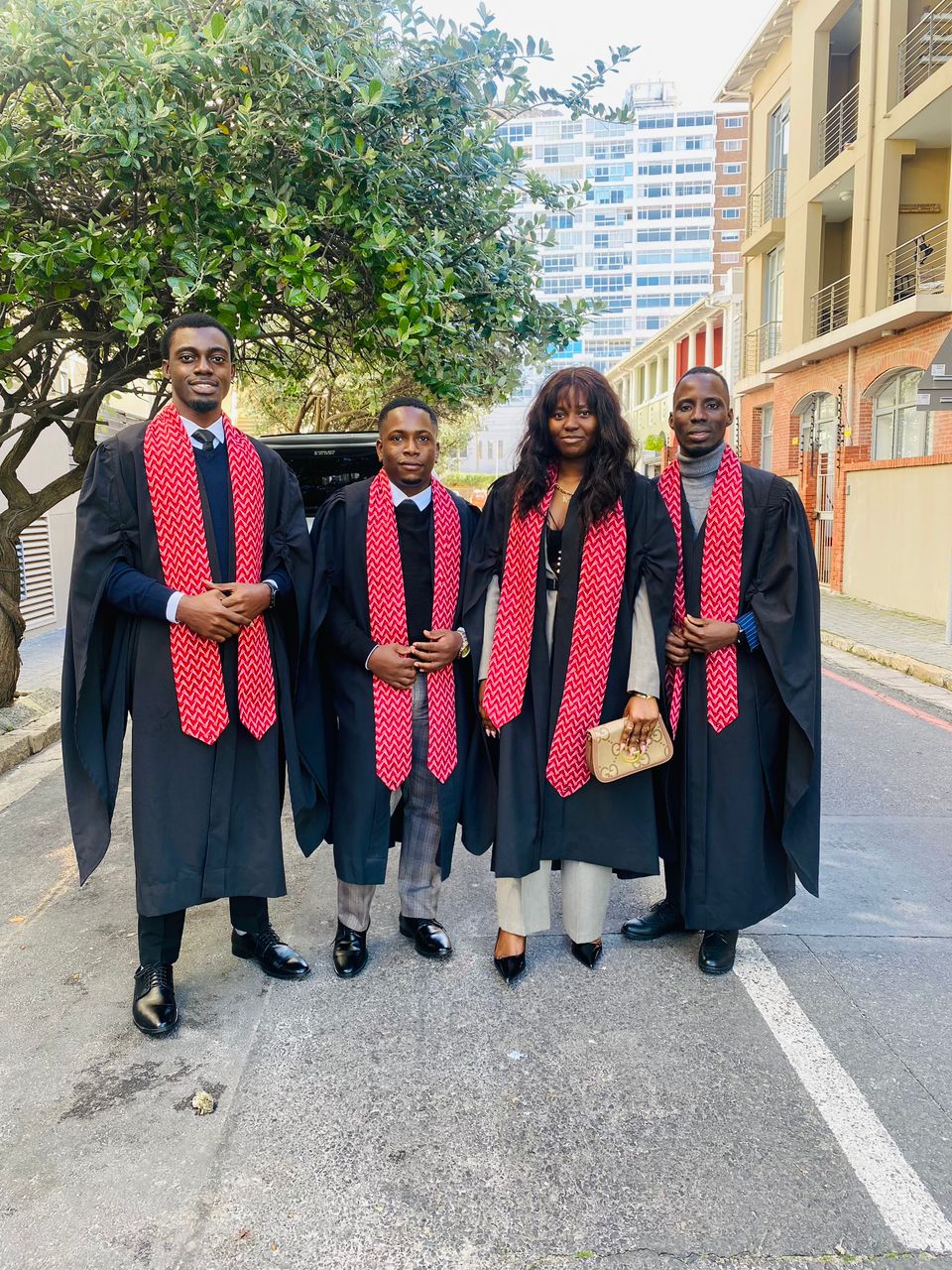
At AIMS with fellow scholars
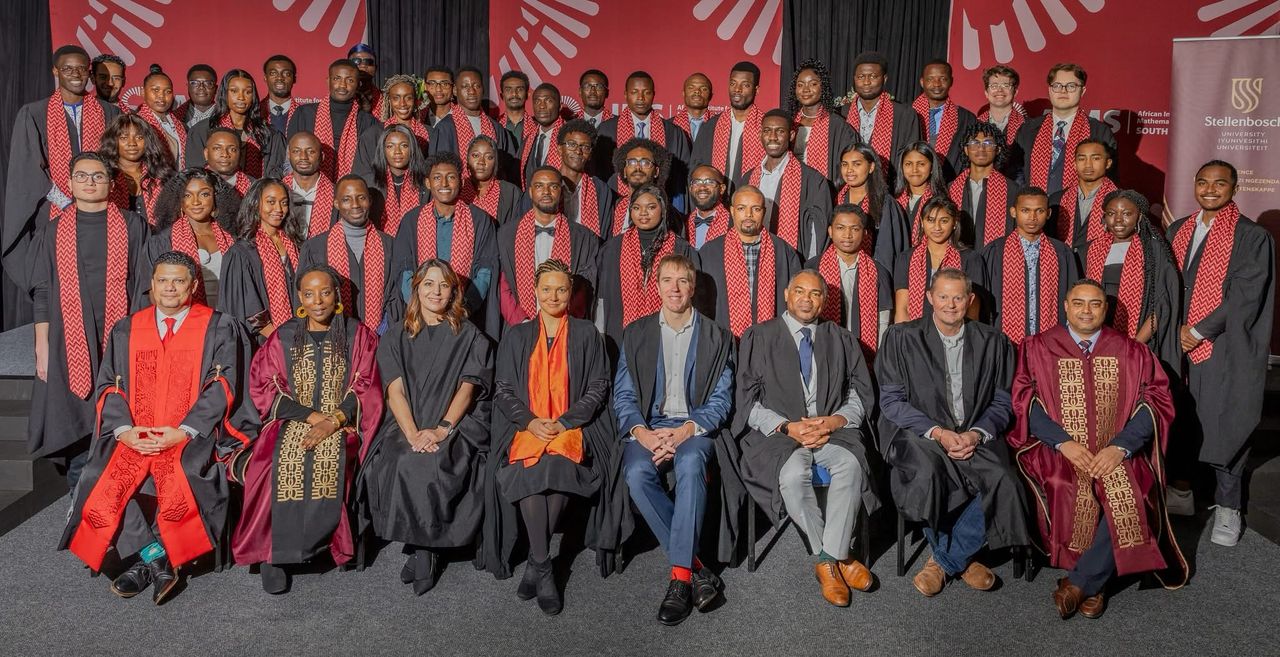
Graduating with Distinction from the African Institute for Mathematical Sciences, alongside fellow scholars from across the continent.